
Minestra maritata
This staple of Christmas Day tables in Naples became the much beloved if mistranslated Italian-American Wedding Soup

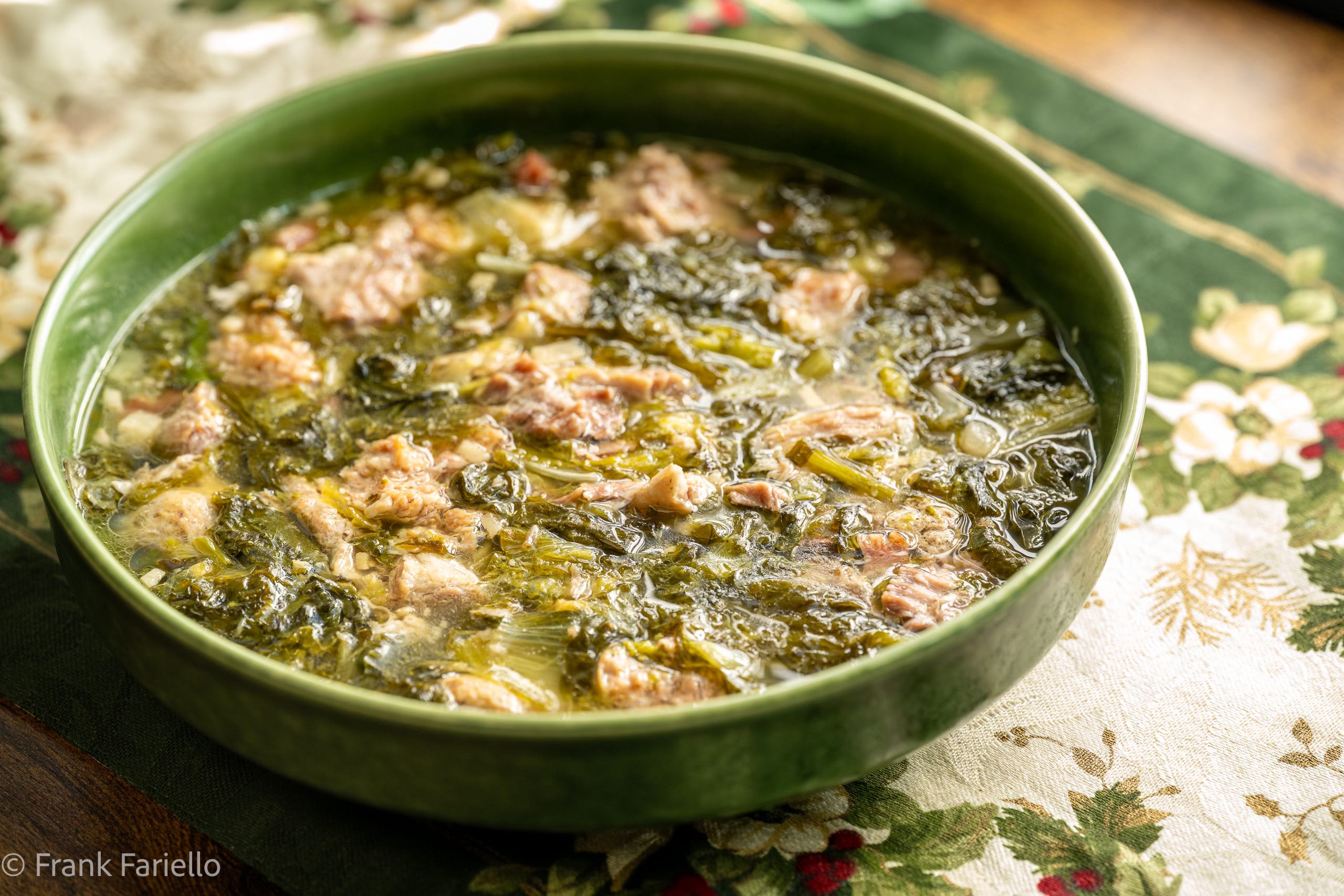
Minestra maritata, literally meaning ‘married soup’, is a dish that marries a variety of different cuts of meat—traditionally a mix of cured and fresh pork, but nowadays it can include chicken and beef—with a variety of different leafy greens. Once upon a time, this dish practically defined Neapolitan cookery, and it remains a popular dish today, particular at holidays like Christmas and Easter. A rather different version of it, mistranslated as Wedding Soup, is a much loved Italian American classic.
There are probably as many recipes for minestra maritata as families that make it. For this one, I took inspiration from Jeanne Caròla Francesconi’s iconic cookbook La cucina napoletana,, but I’ve adapted her hyperlocal recipe for non-Italian kitchens with reasonably priced ingredients that should be fairly easy to find in a well-stocked in supermarket or Italian deli.
Though the recipe calls for a prodigious number of ingredients and takes a good three hours or more to make, the basic method for making minestra maritata is actually very straighforward. First you simmer the meats in a large pot of water until tender, which produces a rich broth. Then you add the greens to the broth and simmer them until tender. The cooked meats are then cut or torn up and returned to the pot. The eponymous marriage takes place as meats and leafy greens simmer together for a few minutes before serving.
Minestra maritata is a fixture of Christmas Day and Easter tables in Naples. At Christmas, it provides a simple if hearty repast after the elaborate mulitcourse seafood dinner that is typically served on Christmas Eve. Though it might be a soup, minestra maritata is hefty enough to serve as a one-course meal or piatto unico, rather than a mere primo. It’s a real treat whether it’s Christmas Day or anytime you’re yearing for something warming on a cold winter’s day.
Volunteers wanted
This recipe reminds me to remind all of you that I’m working with a long time fan of the blog, Marco Padovani, on an English translation of Francesconi’s La cucina napoletana. Marco has done 99% of the work, including the actual translating. I’m helping with reviewing and editing the text and brainstorming how to approach publishers.
We’re hoping that the recent publication of The Talisman of Happiness in English, which is already a best seller, will provide a kind of spring board for introducing this classic work to the English speaking public.
One idea we’ve been discussing is crowd sourcing the recipe testing. Francesconi’s recipes are written for a very different time and place, and her recipe for minestra maritata is a case in point. So it makes sense to test her recipes to see if they work in today’s non-Italian kitchens.
If you want to be part of this exciting project as a recipe tester, please reach out directly to Marco at padovaniml@msn.com.
In the news
If you’re a fan of Italian cuisine, you have probably heard by now, but I couldn’t not mention this momentous news.
UNESCO has designated Italian cuisine and its rituals as part of humanity’s intangible cultural heritage. The agency described Italian cuisine as a “means of connecting with family and the community, whether at home, in schools, or through festivals, ceremonies and social gatherings”. We couldn’t agree more.
You might also like…
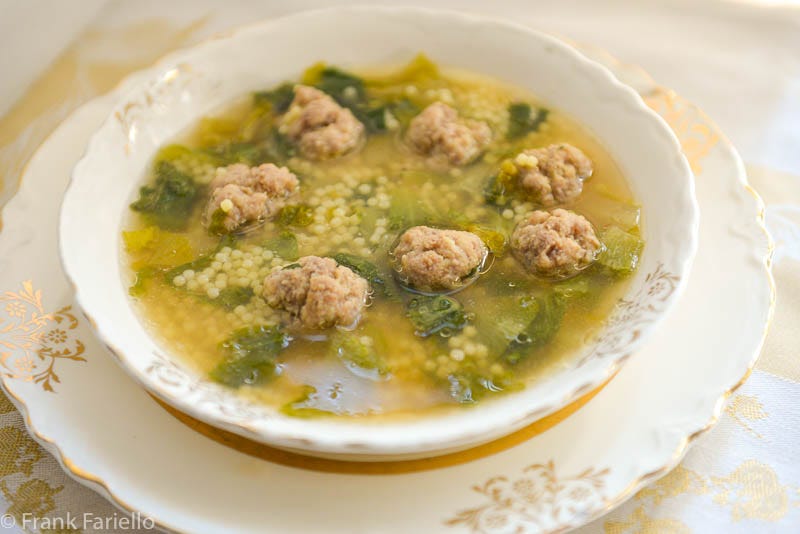
Wedding Soup
Here’s what happened to minestra maritata when it crossed the Atlantic Ocean, one of very few cases where the New World version is actually simpler and lighter than its Old World counterpart.
Wedding Soup is a delicate bowl of tiny meatballs and escarole briefly simmered in abundant broth. Most recipes also call for pasta—missing from minestra maritata—for good measure. Unlike minestra maritata, which is usually reserved for special occasions like Christmas or Easter, so long as you have the broth on hand, you can whip up a Wedding Soup any time in well under an hour.
In any event, while it may be simpler and lighter than minestra maritata, Wedding Soup is plenty tasty. And very comforting, perfect for these chilly autumn evenings, warming but not too filling at the same time.
Naples isn’t the only regional cuisine with delicious holiday soups. Here are some toothsome and rather lighter options for your holiday table:
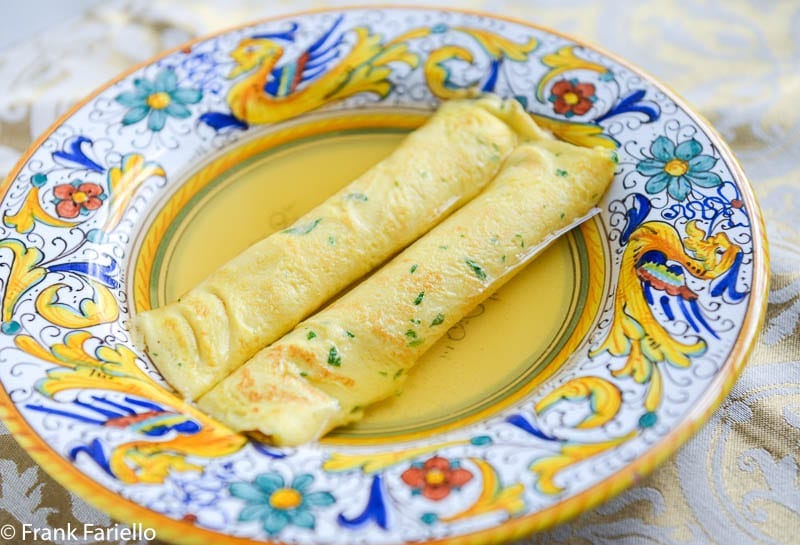
Scrippelle ‘mbusse (Crepes in Broth)
This lovely dish comes to us from the region of Abruzzo. Scrippelle ‘mbusse, literally meaning ‘wet crepes’ in local dialect, are just that: light crepes (crespelle in standard Italian) that are filled with grated cheese, rolled up and doused with hot homemade broth. Sounds simple—and it is—but the combination is pure genius.
Scrippelle ‘mbusse are light but very satisfying. And though made with simple ingredients, it looks quite elegant on the plate, so it is equally at home at a family supper or as a first course for an elegant dinner party. Or on your Christmas table. This warming dish is commonly associated with the colder months, but I’d be happy to tuck into a bowl of scrippelle at any time of year.
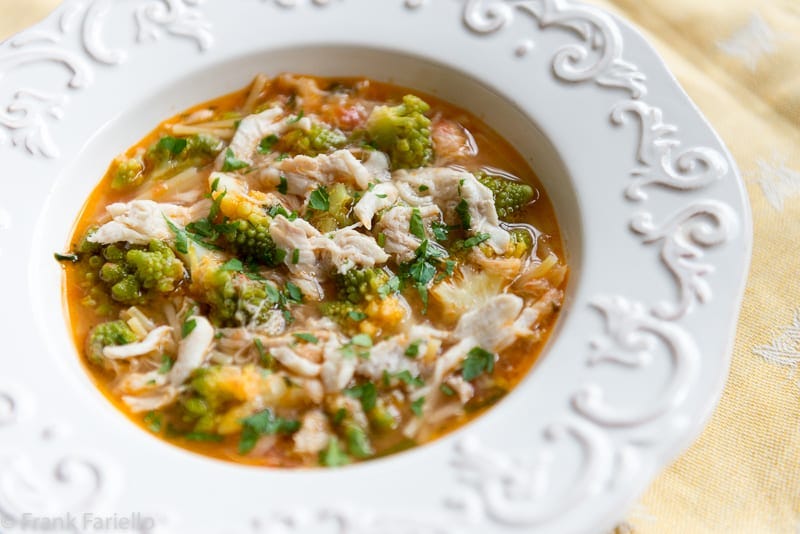
Minestra di broccoli e arzilla (Skate and Romanesco Broccoli Soup)
Like many Roman classics, this humble soup is quite simple to make: you start with a broth made from the skate, which is added to the Romanesco broccoli which you’ve begun to sauté with a tomato-tinged soffritto. Everything simmers together until the broccoli is tender, then pasta is added to the pot and the simmering continues until it, too, is tender. The skate is shredded and added to the soup. It’s a unusual, even seemingly odd, combination of flavors, but it does work, and works very well.
Minestra di broccoli e arzilla makes a nice primo, or first course, for a traditional Christmas Eve fish dinner.
What a great project, Frank! P.S. those scripelle are calling my name.
May I trouble you for the recipe for the Minestra di broccoli e arzilla? Looks like a nice twist on our usual seven fishes!